Most importers discover the problem the same way. You place an order overseas, pay a 30% deposit up front, then pay the balance against shipping documents before the container has left port. The goods spend five or six weeks at sea, another week or two clearing into your warehouse, and then you sell them to a customer on 45-day terms.
Count it out and your money sits in someone else’s account for the better part of four months. Do it once and it stings. Do it every month, with each order bigger than the last, and growth starts to feel like it is quietly bankrupting you.
Trade finance exists to cover that stretch, and it is not only for large corporates.
Where the cash gap actually opens
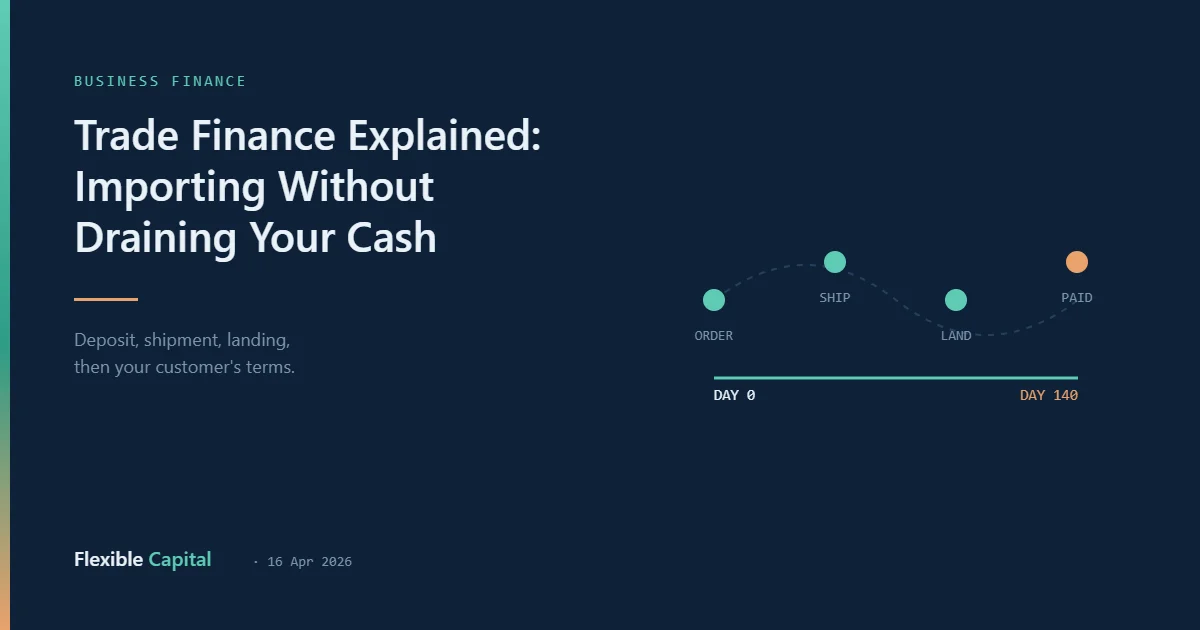
Map your own cycle before you look at any product. Take a hypothetical $500,000 order from a supplier in Guangzhou:
- Day 0: 30% deposit paid, $150,000 out the door
- Day 45: production complete, balance of $350,000 paid against documents
- Day 80: container lands, cleared, into the warehouse
- Day 95: goods invoiced to your customer
- Day 140: your customer pays
That is roughly 140 days from first payment to first receipt, and for most of it you are funded entirely from your own working capital. Now put a second and third order on top, because you cannot stop buying while you wait. This is the arithmetic that traps profitable importers.
What a trade finance facility does
In its simplest form, a financier pays your supplier on your behalf and you repay the financier later — commonly 90 to 180 days later, depending on the facility and the goods. Effectively, you repay once you have sold the stock and been paid yourself. A few things to know up front:
- Facilities can be used for overseas or domestic suppliers, not just imports.
- Some financiers will fund deposits; others fund only against shipping documents. If your suppliers demand deposits, ask this first.
- Facilities are almost always supported by security: typically property, unencumbered assets, or a general security agreement over the business, usually with director guarantees.
- Some financiers will also lend against stock already in your warehouse, which pulls cash forward again at the other end.
One underrated move: if a financier is paying your supplier promptly, you have leverage to negotiate an early settlement discount. A couple of per cent on every order offsets a meaningful slice of the facility cost.
Letters of credit and documentary collections
If you import, you will meet these two instruments. They solve a trust problem rather than a cash problem, though they interact with both.
Letter of credit. Your bank or financier undertakes to pay the supplier once they present documents that comply exactly with the terms — bill of lading, commercial invoice, packing list, certificates of origin or inspection. The supplier ships knowing payment is assured; you know payment only releases against documents proving the goods went on the vessel. New relationships and larger overseas suppliers often insist on one.
The catch is that they are documentary: the bank checks paperwork, not what is in the container. They are also unforgiving, and a discrepancy as small as a mismatched description can hold up payment and cost fees to amend.
Documentary collection. A lighter-touch alternative. Your supplier’s bank sends the shipping documents to your bank, which releases them to you against payment or against your acceptance of a term draft. It is cheaper and quicker, but there is no bank undertaking to pay, so the supplier carries more risk. It suits established relationships.
Trade lines and FX exposure
Most facilities are set up as a revolving import line with a limit, drawn order by order and each drawing repaid at the end of its term. Approvals consider the goods themselves — commodity or fashion, perishable or durable, easy or hard to resell — as much as your balance sheet.
The exposure people underestimate is currency. If your order is denominated in US dollars and you pay it out over a 140-day cycle, your landed cost is not fixed on the day you order. A move against you lands straight on your gross margin, and you have almost certainly already quoted your customer in Australian dollars.
Most trade financiers can arrange forward contracts alongside the facility, so you lock the rate when you commit to the purchase rather than when you pay. Do it deliberately rather than by default.
Stacking trade finance with invoice finance
Trade finance covers the front of the cycle: supplier paid, goods on the water, stock landed. Invoice finance covers the back: once you have invoiced your customer, you draw against that receivable instead of waiting out their terms.
Used together, the two close the gap from both ends. The trade facility is repaid, often directly from the invoice finance drawdown, and your own capital stays free for the next order. Lenders are generally comfortable with this structure provided the security positions between the two facilities are agreed up front, and getting that sequencing right is a large part of the work.
When it is the wrong answer, and what to do next
Trade finance is not free and it will not fix a thin margin. If your gross margin cannot absorb the funding cost across a 120-day cycle, the facility only makes a marginal product line unprofitable more efficiently. It also suits a repeatable purchasing rhythm; one-off, opportunistic buying is harder to fund and harder to price.
If it does fit, map your last three orders on a calendar: deposit paid, balance paid, landed, invoiced, paid. That single page tells a financier more than a set of financials will, and it usually tells you whether the answer is a trade line, a stock facility, invoice finance, or some combination.
If you would like someone to look at that timeline with you, the team at Flexible Capital arranges trade and import lines for Australian businesses and is happy to walk through what a facility could realistically cover.