Commercial Loans

Borrowing for the business, not for the household

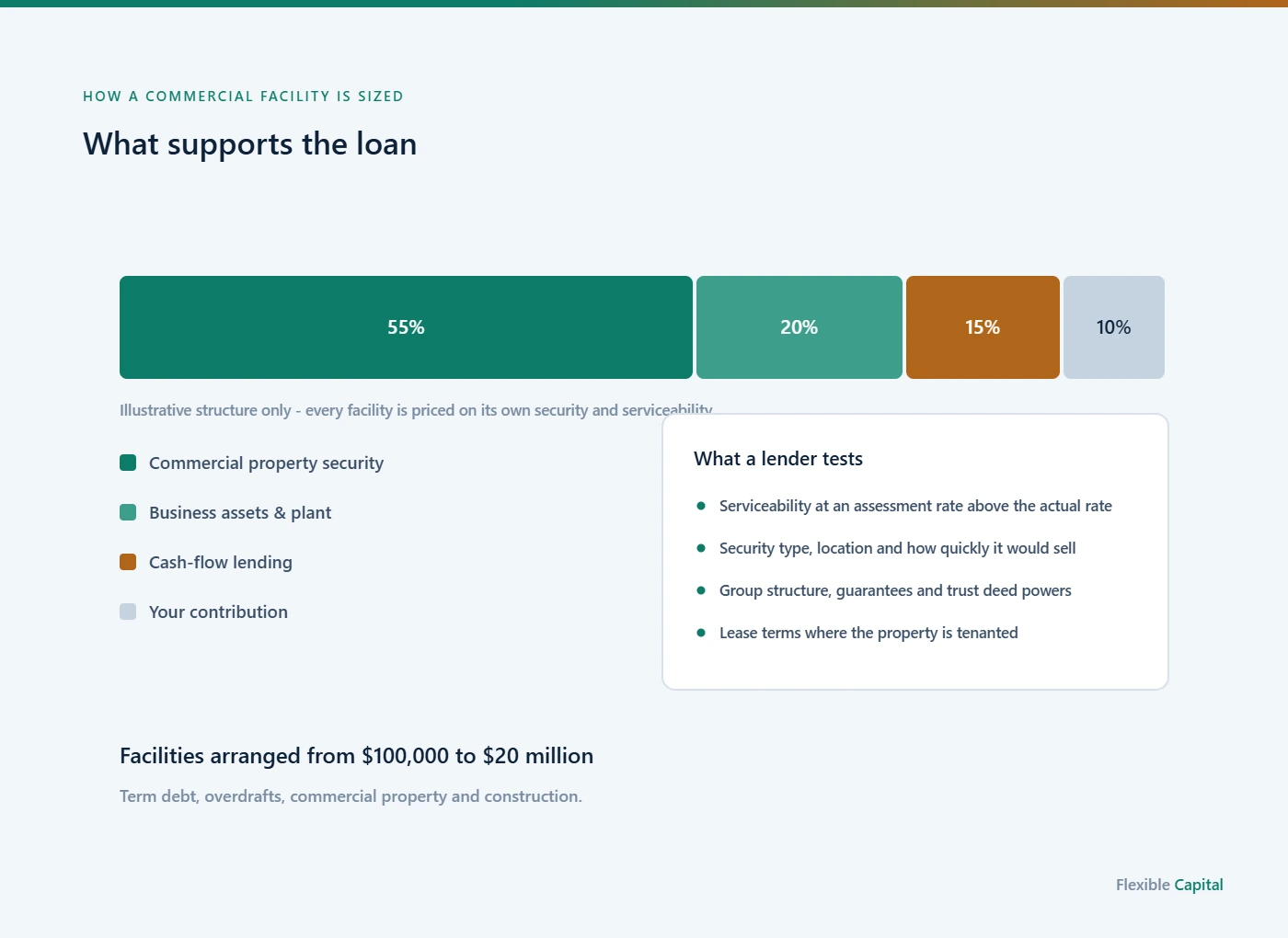
Stacked bar showing an illustrative commercial facility supported by property security, business assets, cash-flow lending and the borrower contribution.

A commercial loan is money borrowed by a business, for business purposes. That is the whole distinction — it is the purpose of the funds that makes a loan commercial, not the type of security behind it. A loan secured against your home but used to buy plant is a commercial loan.

Because they are for business purposes, commercial loans sit outside the National Consumer Credit Protection Act. Fewer prescribed protections, but a great deal more room to structure the facility around what the business actually needs.

We arrange facilities from $100,000 to $20 million.
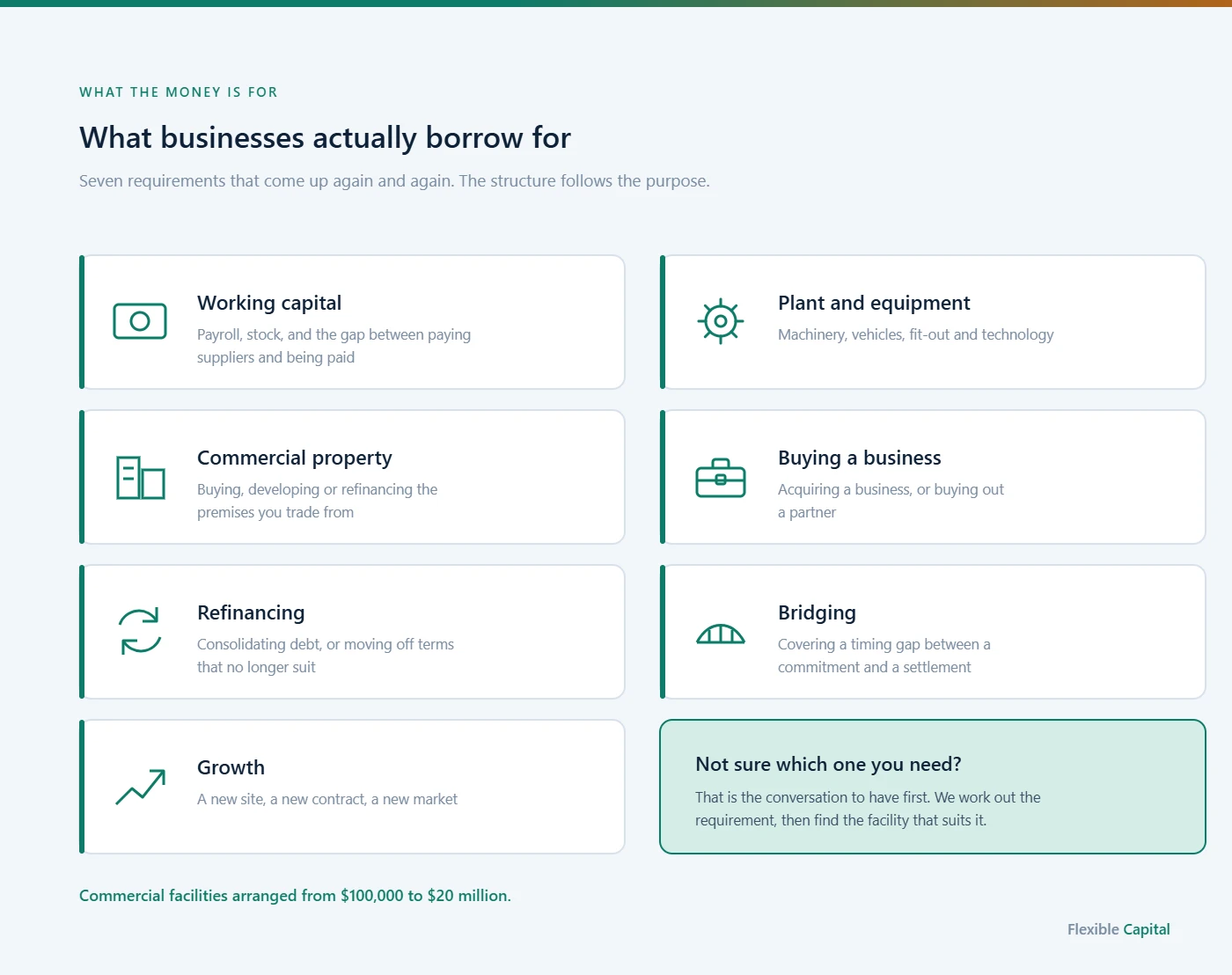
What Australian businesses use commercial loans for: working capital, equipment, property, acquisition, refinancing, bridging and growth

What businesses use them for

  • Working capital — payroll, stock, and the gap between paying suppliers and being paid
  • Plant and equipment — machinery, vehicles, fit-out, technology
  • Commercial property — buying, developing or refinancing your own premises
  • Buying a business — or buying out a partner
  • Refinancing — consolidating debt, or moving off terms that no longer suit
  • Bridging — covering a timing gap between a commitment and a settlement
  • Growth — a new site, a new contract, a new market

How they are secured

Most commercial lending is secured. In Australia that usually means one or more of:

  • Real property — commercial or residential, by first or second mortgage
  • A General Security Agreement (GSA) over the company’s assets, registered on the PPSR
  • Specific security over named plant, equipment or vehicles
  • Accounts receivable — the debtor ledger itself
  • Directors’ guarantees — requested on most SME facilities

Unsecured commercial loans exist. They are smaller, shorter and priced accordingly.
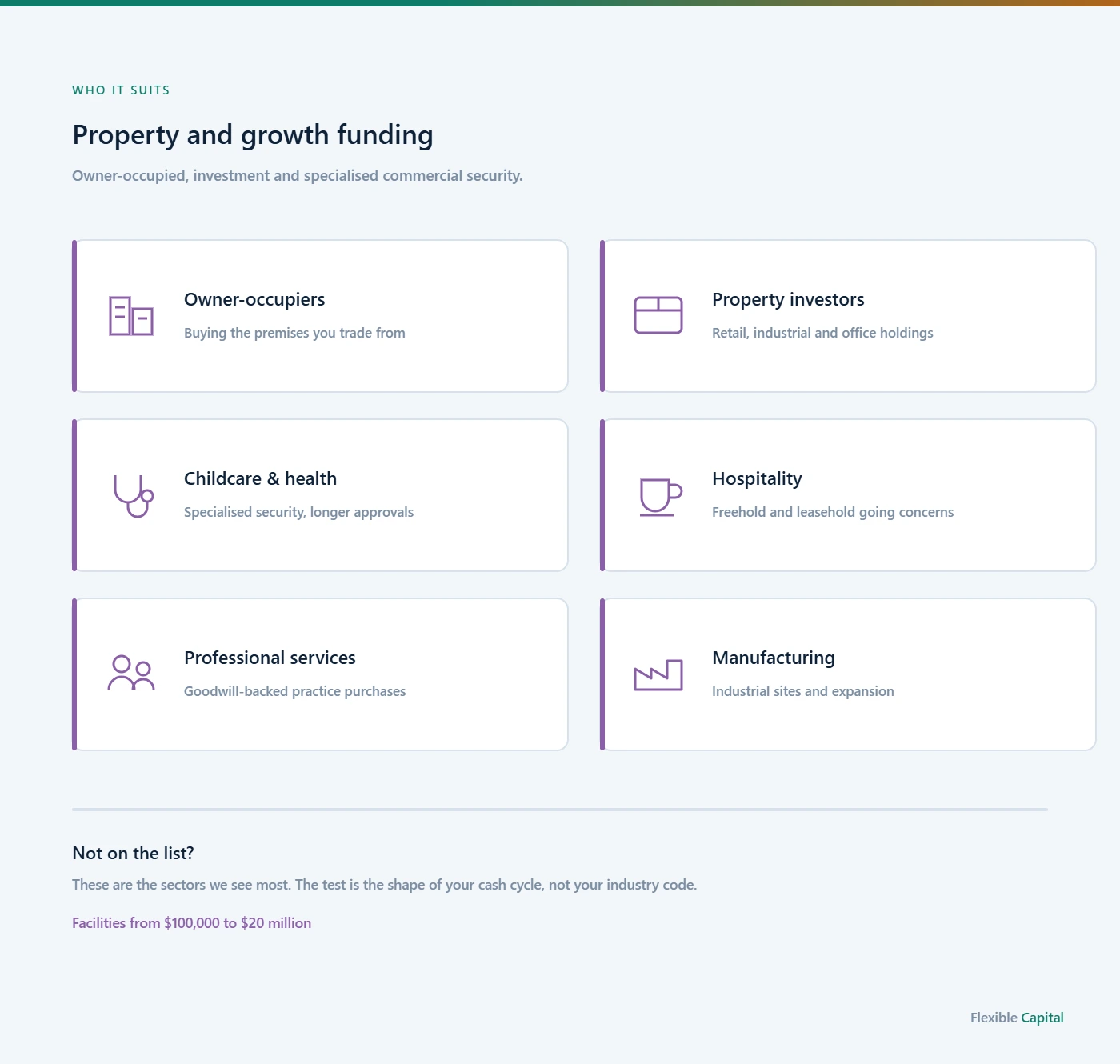
Six industry cards for commercial lending: owner-occupiers, property investors, childcare and health, hospitality, professional services and manufacturing.
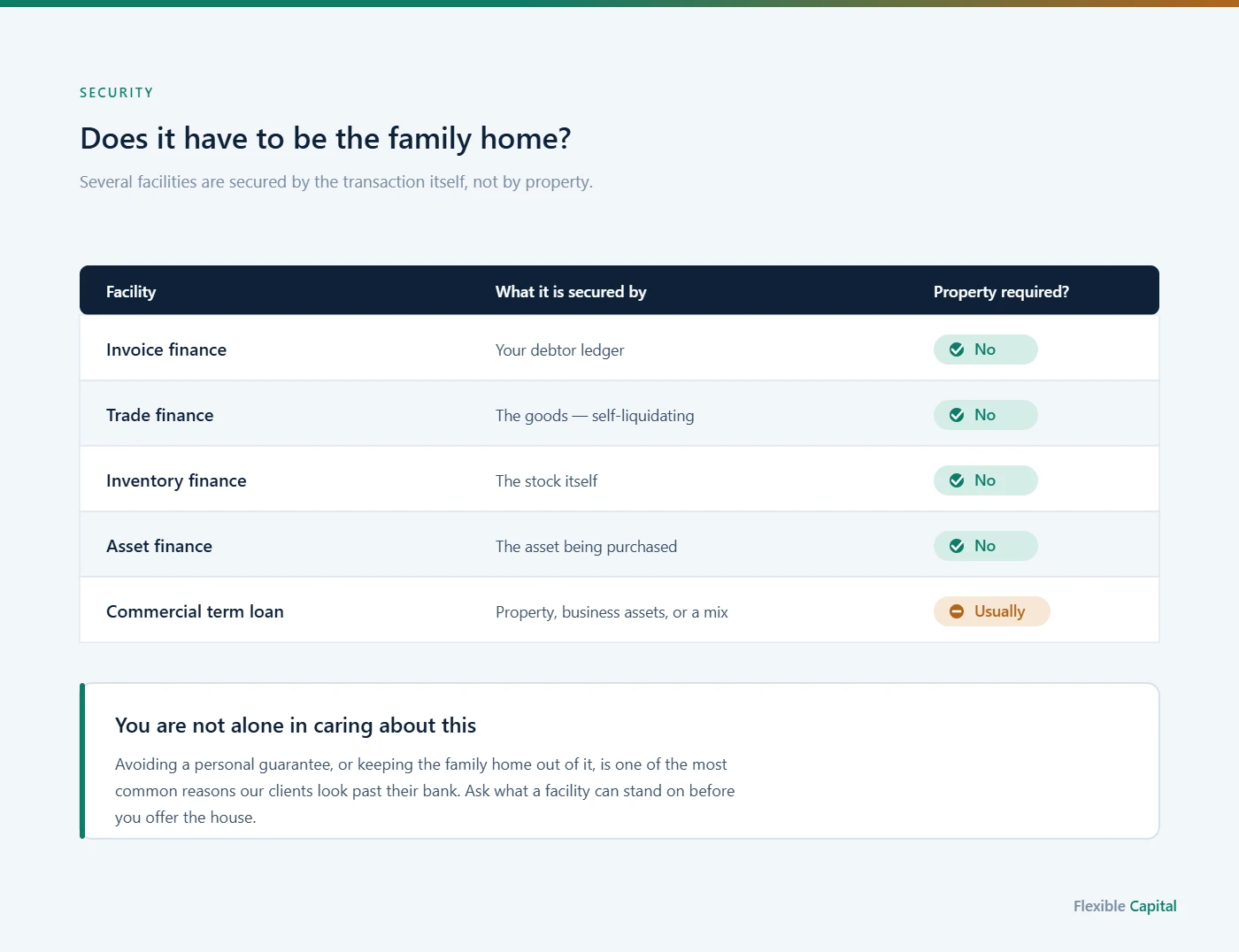
Which business finance facilities are secured by the transaction rather than by the family home

Does it have to be my house?

The most common question we are asked, and the answer is no — not always.

Several facilities are secured by the transaction rather than by property. Invoice finance is secured by your debtor ledger, trade finance is self-liquidating against the goods, inventory finance is secured by the stock, and asset finance is secured by the asset being purchased.

You are not alone in caring about this. Avoiding a personal guarantee, or keeping the family home out of it, is one of the most common reasons our clients look past their bank.

Terms, structure and pricing

Term. Business loans commonly run one to five years. Commercial property lending runs longer — often a three to fifteen year term with repayments calculated over fifteen to thirty years, leaving a residual to refinance at the end.

Repayments. Monthly or quarterly. Principal and interest, or interest-only for an agreed period, or interest-only with a balloon.

Rates. Fixed or variable. Variable commercial rates in Australia are generally priced as a margin over a reference rate, commonly the bank bill swap rate (BBSW) or the lender’s own commercial reference rate. The RBA cash rate influences both, but commercial facilities are rarely priced directly off it.

Fees. Expect an establishment fee, and on revolving facilities a line fee charged on the limit rather than the drawn balance. Add valuation and legal costs, and on fixed-rate facilities, potential break costs if you repay early. Ask for the total cost, not the headline rate.
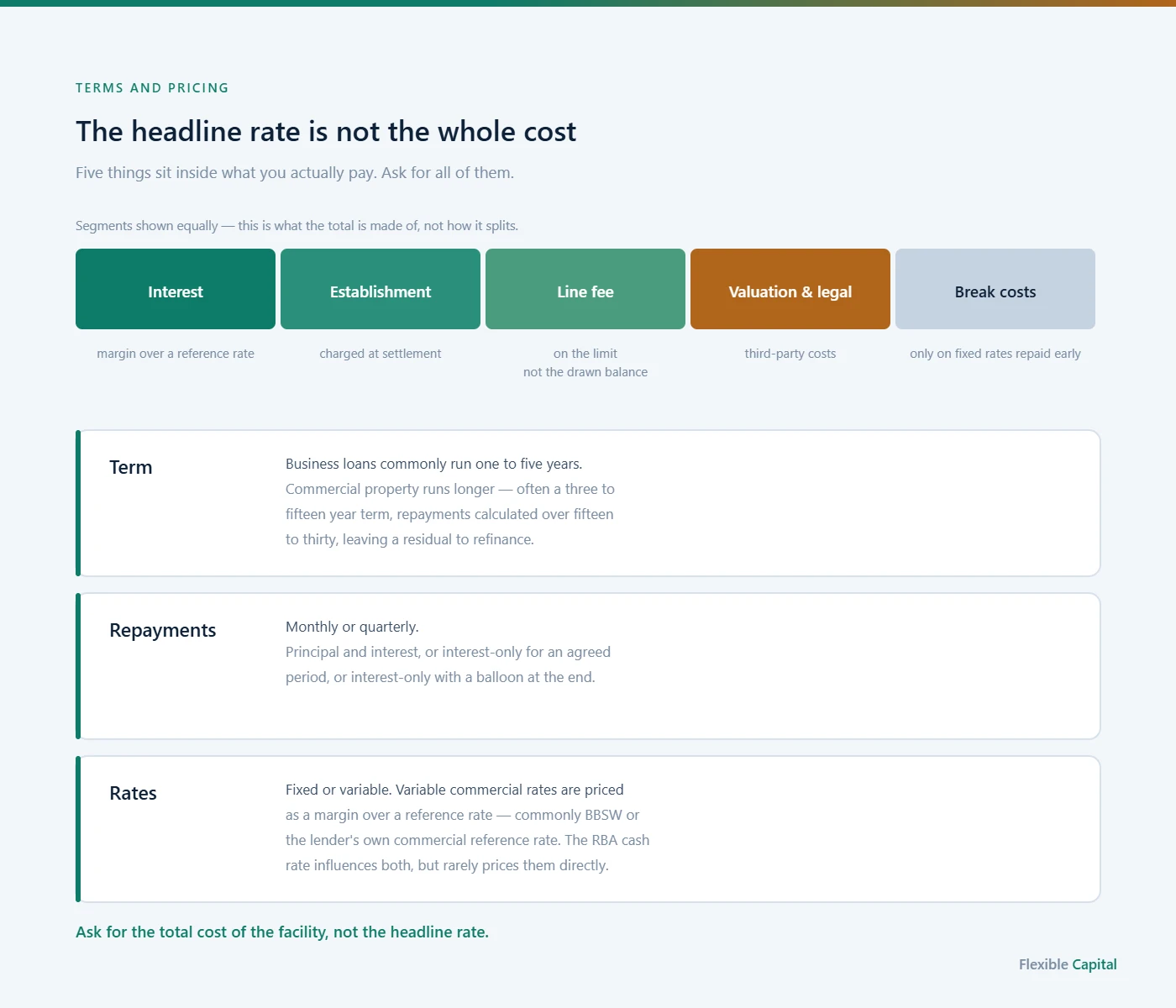
What makes up the total cost of a commercial loan: interest, establishment fee, line fee, valuation and legal costs, and break costs
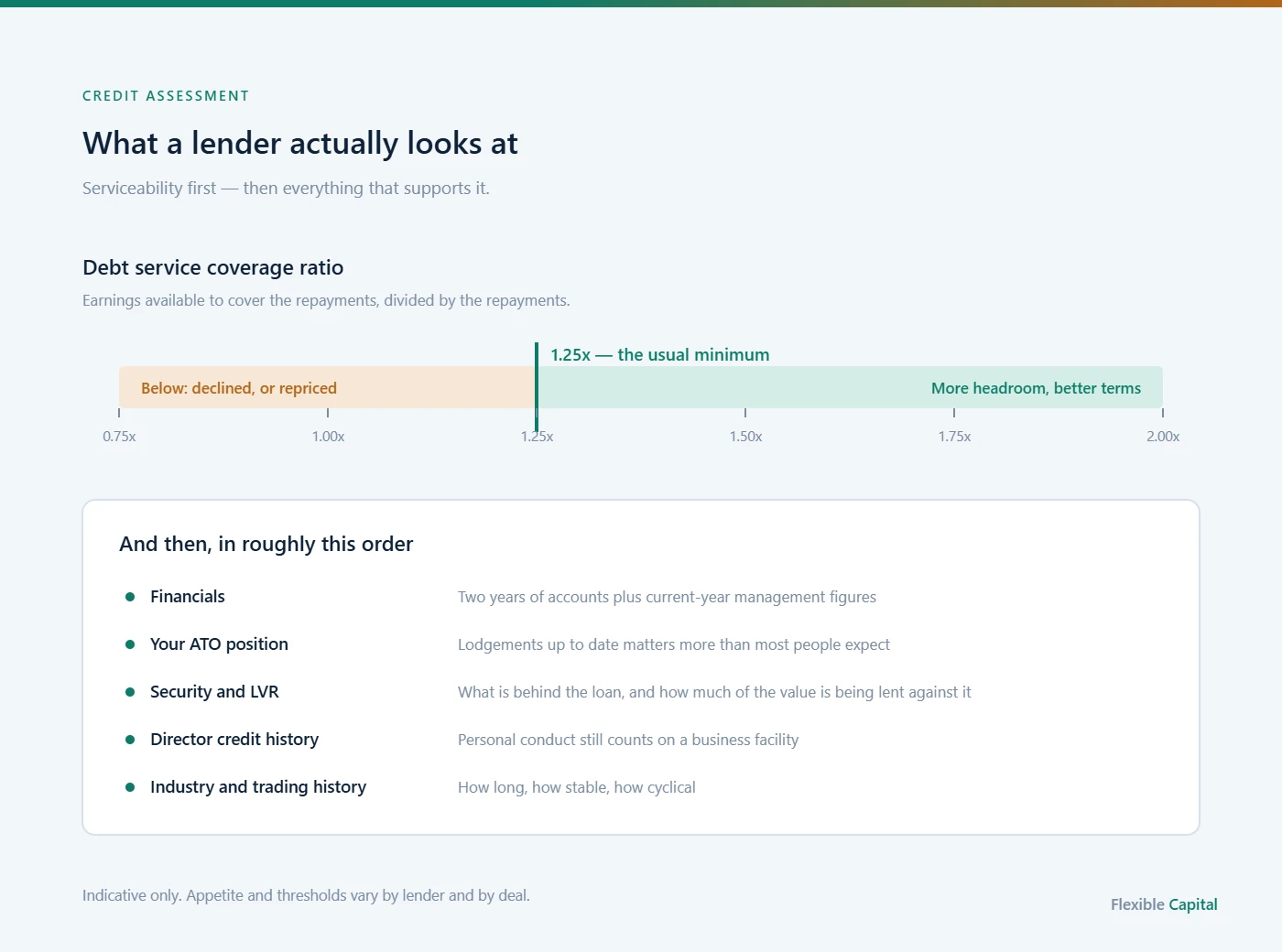
What a commercial lender assesses: debt service coverage ratio, financials, ATO position, security and LVR, director credit history and trading history

What a lender actually looks at

  • Serviceability — most commercial lenders want a debt service coverage ratio around 1.25 times or better
  • Financials — generally two years of accounts plus current-year management figures
  • Your ATO position — lodgements being up to date matters more than most people expect, often more than the balance itself
  • Security and LVR — what is behind it, and how much of the value is being lent against
  • Director credit history
  • Industry and trading history — how long, how stable, how cyclical

Where the money comes from

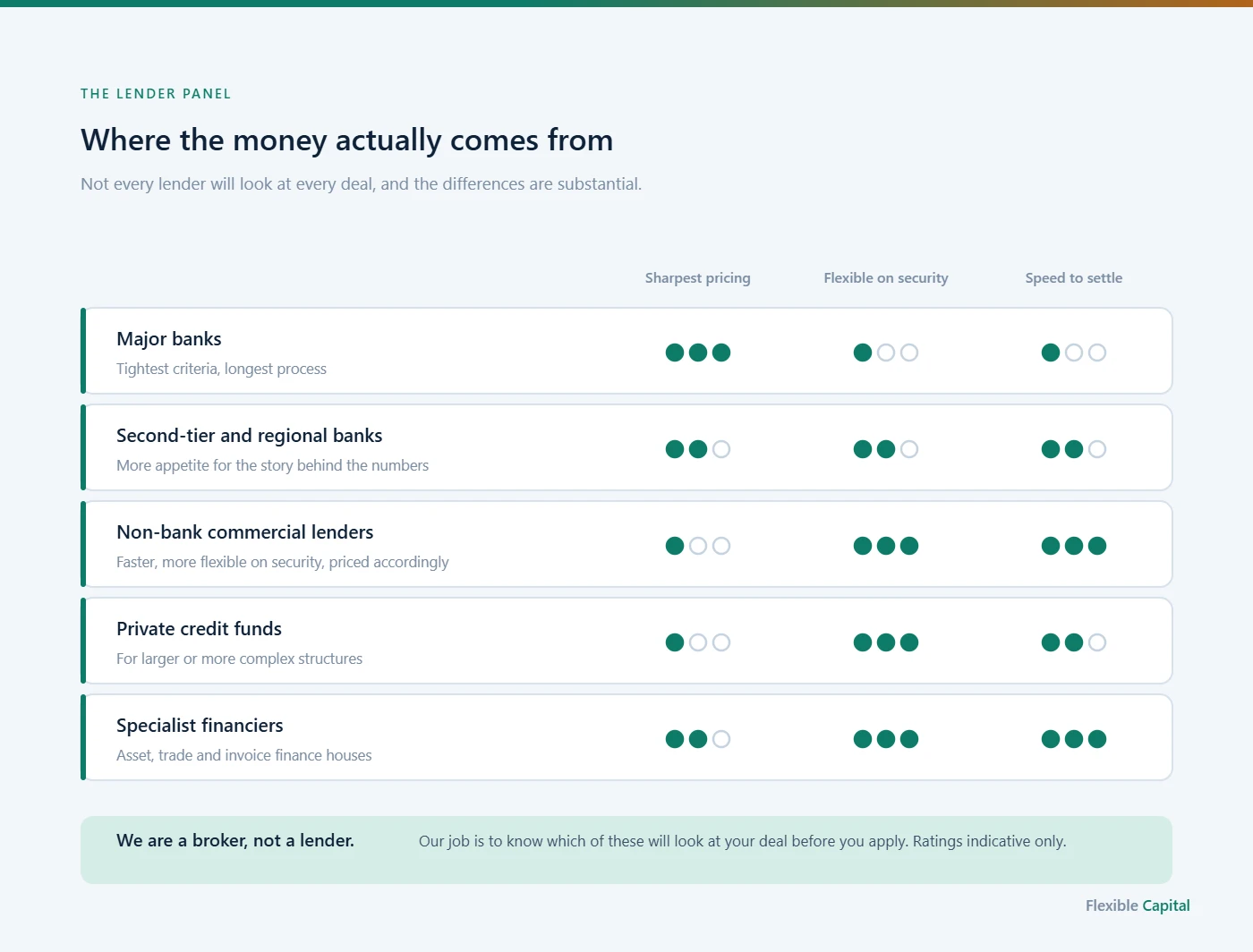
Not every lender will look at every deal, and the differences are substantial:

  • Major banks — sharpest pricing, tightest criteria, slowest
  • Second-tier and regional banks — more appetite for the story behind the numbers
  • Non-bank commercial lenders — faster, more flexible on security, priced accordingly
  • Private credit funds — for larger or more complex structures
  • Specialist financiers — asset, trade and invoice finance houses

We are a broker, not a lender. We do not have one product to sell you, and we are not trying to fit your business to it. What we do is know which lenders will look at a deal shaped like yours, which will not, and what each one needs to see before they say yes. That saves you the credit enquiries, the rework, and the weeks spent finding out the hard way.

$100,000 to $20 million. Indicative structure and lender direction within one business day.
Call 1300 235 394  ·  Request a call back

The Australian commercial lender landscape: major banks, second-tier banks, non-bank lenders, private credit funds and specialist financiers compared on pricing, flexibility and speed