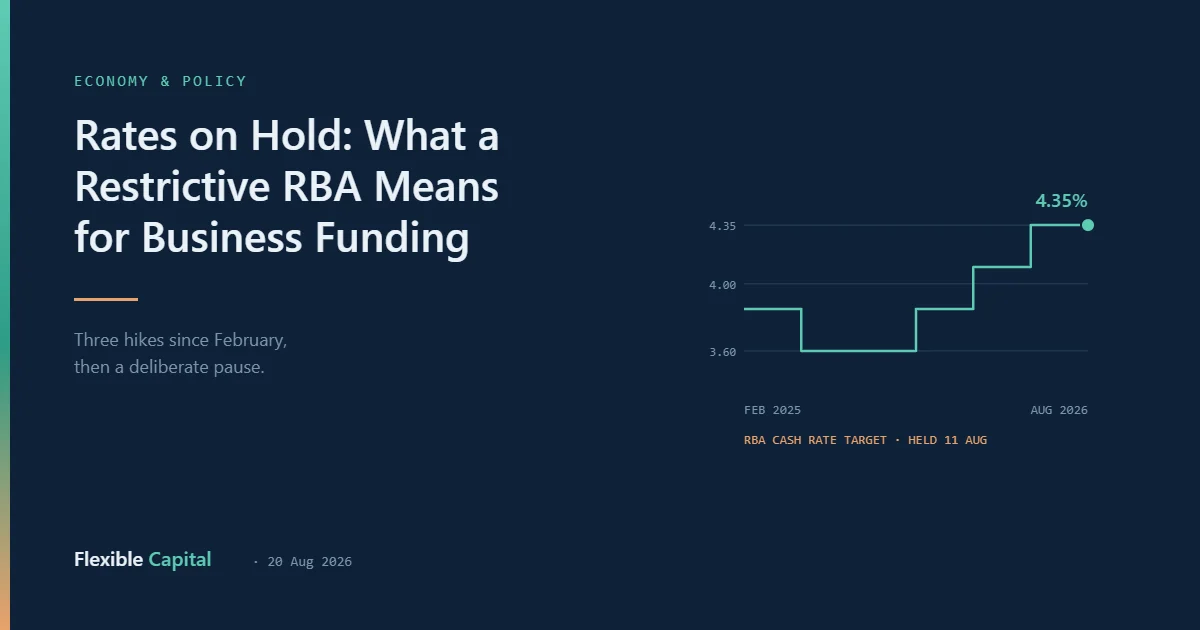
At its meeting on 11 August 2026 the Reserve Bank left the cash rate target unchanged at 4.35% — the level it reached in May after three increases in the first half of the year, which between them unwound almost all of the easing delivered through 2025.
For most business owners that landed as a non-event: no change to next month’s repayment, nothing to do. But a hold at a deliberately restrictive setting is not the same as nothing happening. It is a decision to keep the cost of money high for longer, and if your plans assume relief is coming shortly, it is worth ten minutes of your attention.
Why the Board is holding
The Reserve Bank’s core job is keeping inflation in check. When the economy runs too hot it raises the cash rate — the rate at which financial institutions lend to each other overnight — to slow spending and borrowing. When the economy needs support, it cuts.
Inflation picked up materially through the second half of 2025 and remains elevated. Trimmed mean inflation, the better guide to the underlying trend because it strips out the most volatile price movements, has shown little improvement. Until that changes, policy is intended to be restrictive: rates held above where they would sit in normal conditions, precisely to dampen demand.
The rest of the picture is mixed rather than weak. Labour market conditions have eased somewhat, business investment remains solid, and housing prices are falling in some cities. None of that is the sharp deterioration that would force the Board’s hand quickly, which is why market economists broadly do not expect cuts before 2027 — a general expectation, not a forecast anyone can bank on.
Remember, too, that the cash rate is not the rate you pay. Lenders price a margin over it, and that margin moves with their funding costs, competition and how they view your risk. A hold does not mean your facility is frozen.
Slow debtors cost more when money is dear
The obvious effect of restrictive policy is the interest line in your profit and loss. The less obvious one is bigger. Slower demand means longer sales cycles and slower payment: customers manage their own cash more carefully, so they pay you later, while the money you use to bridge that gap costs more than it did two cycles ago. Not a crisis, but a working capital cycle that has quietly stretched as the cost of funding it has risen.
Every day an invoice sits unpaid you are funding your customer’s business. When money was cheap that was an irritation. At current rates it is a real cost, worth putting a number on.
Take a business invoicing $500,000 a month with debtors averaging 65 days against terms of 35. That 30-day gap is roughly half a million dollars of your money sitting in someone else’s account. Apply whatever your facility costs to that balance — the annual figure is usually larger than people expect, and it buys you nothing.
- Tighten invoicing first. Invoice on completion rather than at month end, get purchase order details right so nothing sits in dispute, and make collections someone’s job rather than a task for when there is time.
- Look hard at your worst payers. A large customer paying at 90 days may be less profitable than a smaller one paying at 20.
- If the delay is structural, because that is how your industry pays, invoice finance releases most of an approved invoice’s value shortly after it is raised, putting a measurable cost against the gap rather than an overdraft you keep rolling.
Fixed or variable on asset finance
With no near-term cuts widely expected, the fix-or-float question on equipment and vehicle finance changes shape.
Fixing buys certainty, not savings. You know the repayment for the term, which makes budgeting and tendering easier, and you are protected if rates move further the wrong way. What you give up is the benefit of any cuts, and fixed facilities are less flexible about early payout — expect break costs if you sell the asset or refinance mid-term. Variable keeps that flexibility and lets you benefit if the cycle turns, but the repayment can move against you.
If the asset underpins a contract with fixed pricing over several years, fixing the finance to match the contract term usually makes more sense, because it locks in the margin you tendered on. And you need not choose one answer for everything: a mixed book across a fleet gives you certainty without betting the whole position on a rate view.
Waiting for a cut is a poor way to decide
The most common mistake in a holding pattern is deferral. The machine gets postponed, the extra site put off, the hire delayed, all until rates come down.
Sometimes that is right. Often it is not, and here is the test. If the investment only works at a materially lower interest rate, it is a marginal investment and the rate is not really the problem. If it works at today’s rate, delay costs you the return you would have earned meanwhile — usually more than the interest saving you are waiting for.
With cuts not widely expected before 2027, “wait and see” is not a short pause. It is potentially a year or more of deferred earnings, ceded to whoever moved.
Facilities priced in a different cycle
If your overdraft, equipment facility or commercial property loan was arranged during the very low rate period, its pricing reflects a market that no longer exists — and so do its limits and structure.
Pull out the documents and check four things: the rate and margin against what is available now; whether limits still match the size of the business; whether an interest-only or fixed period is about to expire and what happens then; and whether the security pledged is proportionate to what you are borrowing.
Refinancing at the same rate can still be worthwhile if it improves the structure — a longer term, a facility that flexes with your season, or security released.
A sensible move this quarter
You cannot influence the cash rate. You can influence your debtor days, your facility mix, and whether your funding matches the shape of your business.
If your facilities have not been reviewed since the cycle turned, that is the work worth doing before the quarter closes. Give Flexible Capital a call and we will go through what you pay, what is available, and whether the structure still fits.