Most business structures are chosen once, early, when the priority was getting an ABN and getting on with the work, then left alone for a decade while the business grows around it.
You find out whether it was the right call at one of two moments: when something goes wrong and someone comes looking for assets, or when you go to borrow and the lender starts asking who exactly is applying. The second is the one we see most often, and the part most articles skip.
What follows is general information. Which structure suits you is a decision for your accountant and lawyer, with your tax position, family circumstances and risk exposure in front of them.
Sole trader and partnership: simple, and personally exposed
A sole trader is one person trading under their own tax file number: no directors, no shareholders, no separation between you and the business. It is cheap to set up, cheap to run, and you keep every dollar of profit.
There is no separation when things go badly, either. Business debts are your debts, and your house is in scope.
A partnership is that same exposure shared between two or more people, plus a wrinkle: a liability created by one partner is a liability for all of them. Partnerships are cheap to establish and each partner can use their share of losses directly. But if a partner dies or exits, the partnership generally must be dissolved and a new one formed — disruptive at exactly the wrong time.
Both work well for genuinely small operations, and both start to creak once there are employees, contracts with real liability attached, or a need to borrow beyond a modest amount.
Company: a separate legal entity
A private company has an ABN and an ACN, is owned through shares and run by directors who may or may not be shareholders. It is a separate legal entity: it can own property, enter contracts and carry debt in its own right.
That separation is a liability buffer, not an absolute one. Director duties, personal guarantees, unpaid superannuation and director penalty notices all cut through it.
Companies are the easiest structure to bring investment into, since you can issue or transfer shares without unpicking the business. The trade-offs are more compliance, more cost, and less flexibility in distributing profit: dividends follow shareholding, so you cannot direct income to whoever has capacity in a given year. Minority shareholders can also end up with little influence.
Trust: flexible on tax, fiddlier everywhere else
A business can also be run through a trust, usually a discretionary (family) or unit trust, with a company as trustee. The trustee runs the business and income is distributed to beneficiaries.
The attraction is distribution flexibility: income can be directed to beneficiaries on the lowest marginal rates, which for a family with several adult members can be worth a great deal. Trusts also give strong asset protection, because beneficiaries do not own trust assets, and some privacy about ownership.
The costs are real. Establishment costs more than a company, and the administration is heavier: distributions must be resolved and documented each year, and the ATO’s attention on distributions to adult children has increased. Restructuring later can trigger capital gains tax.
The part most articles skip: how structure affects your ability to borrow
Every structure can borrow. They do not borrow equally easily.
Director and personal guarantees
For any SME facility, expect the individuals behind the business to guarantee it. A company will not spare you a guarantee, and lenders assess the guarantors’ own position: home equity, existing debts, other directorships. Structure changes who signs, not whether recourse exists.
Trust deeds lenders will and won’t accept
This is the one that delays deals. Lenders read the trust deed looking for specific powers: to borrow, to give security, to guarantee the debts of others, and clarity on who can bind the trust. Older deeds and deeds drafted for passive investment regularly fail that test.
The fix is a deed amendment, which takes time and can carry stamp duty or tax consequences. If your business sits in a trust, get the deed reviewed before you go to market, not after credit asks for it.
Security over trust assets
Taking security from a trust is more involved than from a company. Documents are signed by the trustee in its own capacity and as trustee, guarantees usually come from the trustee company’s directors, and lenders often want the trust’s right of indemnity confirmed. None of it is exotic, just more moving parts, and more parts means more time.
Trusts carry one further quirk. Because a trust distributes its profit each year, it accumulates little in retained earnings, so a lender reading the balance sheet sees a thin equity position even in a highly profitable business. That can be managed — a corporate beneficiary, or simply presenting distributions clearly alongside the accounts — but it has to be managed deliberately.
Why lenders want the whole group
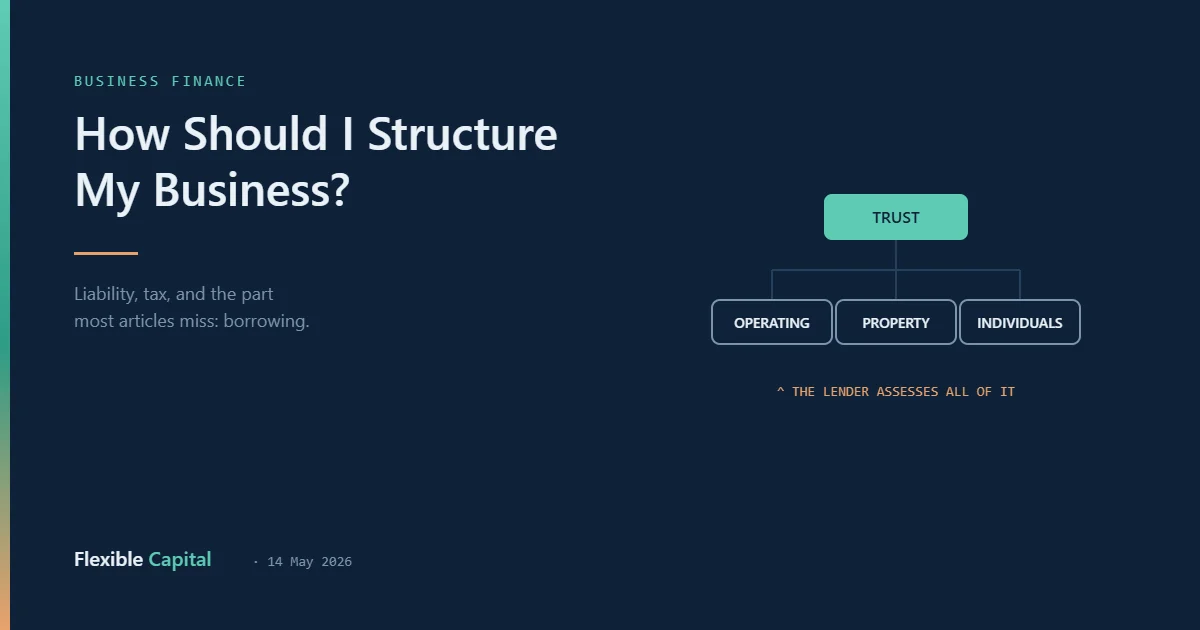
If your business is a company that leases its premises from a family trust, and a second company employs the staff, the lender wants to see all of it. Credit assesses the group, not the entity on the application form, because that is where the real cashflow and assets sit.
Groups that can produce consolidated figures, clean intercompany positions and a diagram of who owns what get faster answers. Groups that cannot are asked more questions and often priced accordingly.
Where to start
If you are setting up, talk to your accountant about tax and your lawyer about liability before you register anything. If you are already trading and weighing a change, ask the question few people do: what will this do to our ability to fund the business in three years?
We cannot tell you which structure to adopt. But if you want to know how a proposed structure will read to a credit team before you commit, talk to Flexible Capital first. It is far cheaper than restructuring after a decline.