Your profit and loss says you made money last quarter. Your bank balance disagrees. Most owners know that feeling, and most put it down to timing.
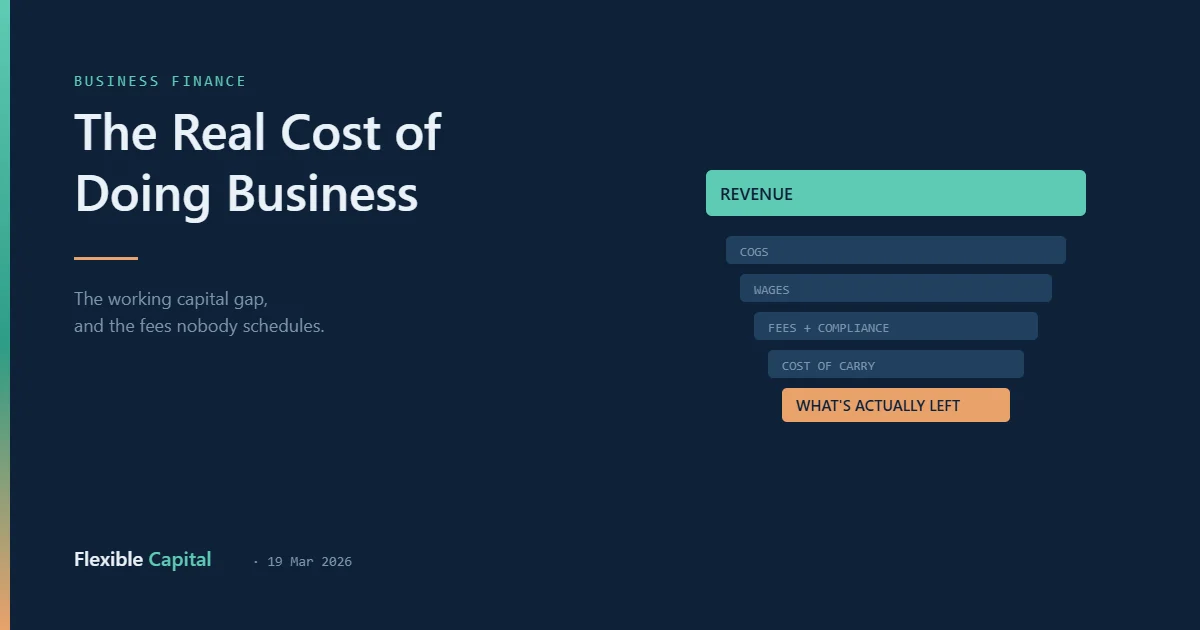
Timing is part of it. The rest is a set of costs that never appear as a line item you’d think to question. They sit inside your cost of goods, your bank statement and your working capital, taking a slice of every dollar you turn over.
What follows is a diagnostic, not a pitch: how to find where your margin goes, so that when you price a job you work from real numbers.
Start with the gap between paying and getting paid
Every business funds its own growth for a while. You pay for materials, wages, fuel and subcontractors before your customer pays you, and the longer that gap runs, the more cash you need simply to stand still.
This working capital gap has a real cost even when no interest is charged on it. Money tied up in unpaid invoices and unsold stock can’t fund a deposit on equipment, a bulk-buy discount, or the wages of the person who would let you take on more work.
Growth makes it worse: more revenue generally means proportionally more working capital, funded from profit, from the owner, or from a facility. Undercutting a competitor to win volume, without knowing what that volume costs you in cash, is how profitable businesses get into trouble.
Measure your cash conversion cycle
The cash conversion cycle tells you how many days your money is locked up between paying a supplier and being paid by a customer. It is three numbers and one subtraction, built from your own accounts in an afternoon.
- Days sales outstanding (DSO), how long customers take to pay: average receivables ÷ credit sales, × days in the period.
- Days inventory outstanding (DIO), how long stock sits: average inventory ÷ cost of goods sold, × days in the period.
- Days payables outstanding (DPO), how long you take to pay suppliers: average payables ÷ cost of goods sold, × days in the period.
Then CCC = DSO + DIO − DPO.
Say your average receivables run at $850,000 on credit sales of $6 million a year: a DSO of about 52 days. Stock turn gives a DIO of 40 days, and you pay suppliers at 30. Your cash conversion cycle is 62 days, so every dollar of growth must be funded for two months before it returns.
Those figures are illustrative, the exercise isn’t. Run it on your own numbers, then again by customer segment. Most businesses find one or two customers, or one product line, dragging the average out.
The fees that never appear in a budget
Individually these look trivial. Together they often cost more than a full-time employee.
- Merchant and payment fees. Differing rates for debit, credit and international cards, plus per-transaction minimums, bite hardest on low-value, high-volume sales. Ask your provider for a 12-month fee summary, not one month.
- Platform and marketplace commissions. If you sell through a marketplace, booking platform or channel partner, that commission is a cost of sale and belongs in gross margin, not overheads.
- Subscription creep. Software seats for staff who left, duplicated tools, annual plans that renewed without anyone noticing.
- Insurance and compliance. Premiums, workers compensation, licence renewals, audits, certifications, and payroll tax once you cross a state threshold. Payroll tax catches growing businesses off guard, because you reach the threshold without deciding to.
None are avoidable in full, but all are measurable: put them in one schedule as a percentage of revenue and review it annually.
Stock that sits still
Inventory hides best, because it sits on the balance sheet as an asset. In practice, slow-moving stock costs you storage, insurance, handling, obsolescence, and the return you could have earned by putting that cash elsewhere.
Age your stock the way you age your debtors. Anything that hasn’t moved in twelve months is not inventory, it’s a decision you haven’t made, and discounting it to clear is usually cheaper than carrying it.
This is where opportunity cost matters. The cost of not doing something is real even though it never appears in the accounts. Turning down a job for lack of working capital costs you the margin on that job, and sometimes the larger job behind it.
When short-term credit becomes permanent funding
An overdraft or business credit card is designed to smooth a short-term mismatch. Plenty of businesses instead sit near their limit year-round, paying the highest rate in their funding stack against what is really a permanent requirement.
Two things follow: you pay more than you need to, and you have no headroom when something unexpected arrives. With the Reserve Bank having lifted the cash rate twice already this year, to 4.10% in March, carrying a permanently drawn revolving facility is not a trivial cost.
If your overdraft has not been back to zero in twelve months, it isn’t an overdraft. It’s term funding wearing the wrong structure, and it belongs in something priced and sized for the job, whether that is a working capital facility, an invoice finance line, or equipment finance that releases the cash you sank into a machine.
Turning the diagnosis into a decision
Work through it in order: calculate your cash conversion cycle, schedule your fee and compliance costs as a percentage of revenue, age your stock, and check whether any short-term facility has quietly become permanent. That gives you a number for what your current structure costs, which is the only fair basis for judging whether a different one would cost less.
Tax and structuring questions here are worth running past your accountant, since the answer depends on your entity and circumstances.
If the numbers point to a funding mismatch rather than a margin problem, the team at Flexible Capital can walk you through what the alternatives would cost and whether the change is worth making.