Buying a franchise is often sold as the safe way into business ownership. The model is proven, the brand is already known, and someone else has made the expensive mistakes for you.
Some of that holds up. But a franchise is not a job with a shopfront attached, and it is not a guaranteed income. You are buying a licence to run someone else’s system, under their brand, on their terms, for a fixed period. Whether that is a good buy depends on the specific brand, the specific site and the specific agreement in front of you.
What you are actually buying
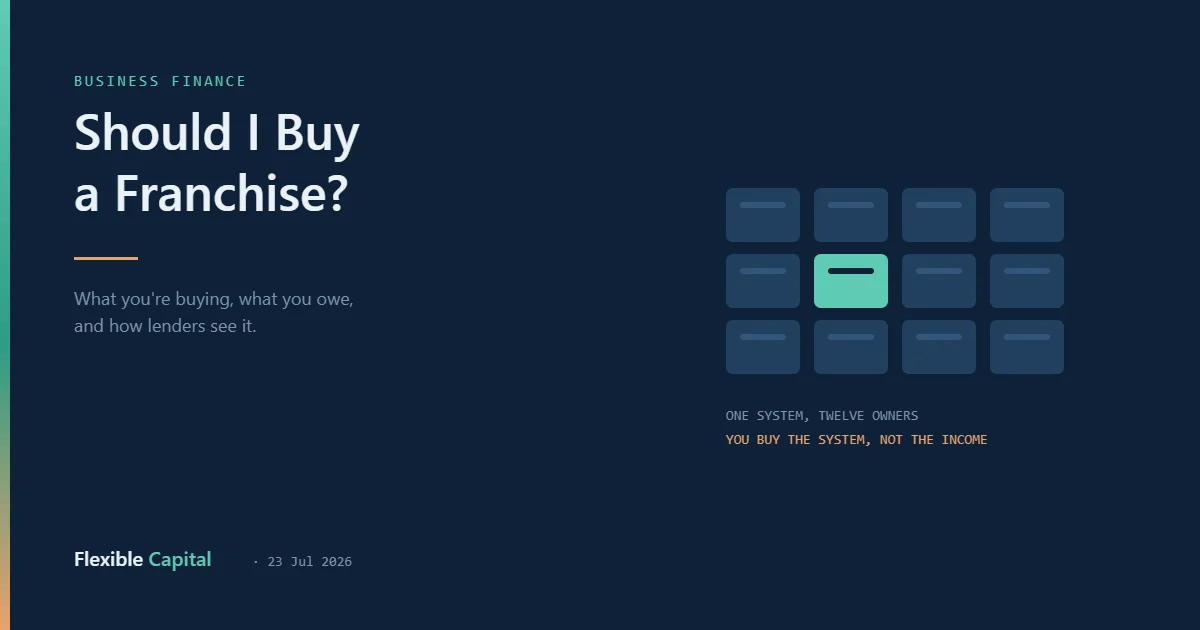
Brand awareness is the real asset. A proportion of customers will walk past an unfamiliar competitor because they already know what they will get from you. That is worth paying for where brand drives the choice. Where customers decide on price, convenience or the person doing the work, it is worth much less.
The system is the other half: tested layouts, supplier agreements, training, marketing calendars, and bulk purchasing an operator of your size could never negotiate alone. Many franchisors also provide a business development manager who can tell you what the strong operators do differently.
What you are not buying is certainty. Every network holds strong performers and weak ones, and the gap comes down to site, cost base and operator — the three things that decide any small business.
The two documents that decide everything
Before you sign, you need two documents in front of you: the disclosure document and the franchise agreement.
Franchising in Australia is governed by the Franchising Code of Conduct, a mandatory industry code that sets out obligations on franchisors, including giving prospective franchisees a disclosure document before they commit. We are deliberately not summarising the Code here — it has been amended more than once and the detail matters. Engage a lawyer who does franchising work specifically. That advice costs a fraction of what you are about to commit.
Read the disclosure document for what it says about current and former franchisees, how many have left, and any history of disputes. Read the agreement for the terms that will govern the next five or ten years: fees, territory, term, renewal, what happens if you want to sell, and what happens if the franchisor decides you are underperforming.
The fees do not stop at the entry price
The upfront fee is the number everyone focuses on. It is rarely the number that decides whether the business works.
- Royalties. How much, and — the important part — are they charged on turnover or on profit? A royalty off the top line is payable whether you make money or not. Ask whether it is negotiable. Sometimes it is.
- Marketing levy. Usually a separate percentage of turnover paid into a national fund. Ask what the fund spent last year and what it produced.
- Fitout and refurbishment. What the initial fitout costs, who specifies it, and whether the agreement obliges you to refurbish partway through the term or on renewal. A mandated refit in year five almost never appears in the opening projections.
- Nominated suppliers. If you must buy through them, compare their pricing to the open market. Group buying power is a genuine benefit, but only when it is passed on.
Then add rent. In a shopping centre, get the foot traffic data and weigh it against occupancy costs. Check the size, too: paying for floor space you do not use is a slow leak, and relocating later is expensive.
Territory, term and renewal
Territory. Is it exclusive? Can the franchisor open another outlet nearby, or sell into your area online or through wholesale? In some industries clustering helps. In others, a second store two suburbs away halves your trade.
Term. Match the franchise term against the lease term. A five-year franchise on a three-year lease — or the reverse — creates a problem you will have to solve at the worst possible moment.
Renewal. Understand on what basis the agreement can be renewed, what it costs, and what the franchisor can require of you then. Renewal risk is also resale risk: a buyer will pay less for a business with two years left to run and no clarity about what follows.
Why lenders look at franchises differently
This is where franchising has a real advantage. A start-up has no trading history, so a lender is being asked to fund a forecast. A franchise of an established brand comes with something closer to evidence: comparable stores with actual revenue and cost data, and a franchisor who knows what a site like yours should turn over.
Several lenders maintain accredited franchise lists and run specific lending programs for brands they have assessed. For an accredited brand that can mean a faster process, better terms than an independent start-up would be offered, and sometimes a higher proportion of the cost funded.
Be realistic about what a franchise lend looks like, though. Expect to contribute meaningful equity of your own rather than borrowing the whole price, and expect the lender to want security. These businesses are light on hard assets — a fitout is worth little on resale and the brand is not yours to pledge — so lenders commonly look to residential property, or lend less against the business alone. Directors’ guarantees are standard. If your brand is not on an accredited list, that is not a dead end, but the assessment will look much more like a conventional start-up.
Before you sign
Do the diligence that costs nothing: speak to current franchisees you have picked yourself, not the ones the franchisor introduces you to. Ask what they earn, what surprised them, and whether they would buy again. Ask someone who has left the network the same questions. Then put a franchise-experienced lawyer across the agreement and your accountant across the numbers.
If the business stacks up and you want to understand the funding side — what you would need to contribute, what security a lender would look for, whether the brand is accredited anywhere — talk to Flexible Capital before you commit to a settlement date. That conversation is much easier to have early than in the week before completion.