Labour-heavy businesses have a particular cash problem. The wage bill and the subcontractor bill land on a fixed cycle regardless of anything else, while the customers who generate that work pay on their own timetable.
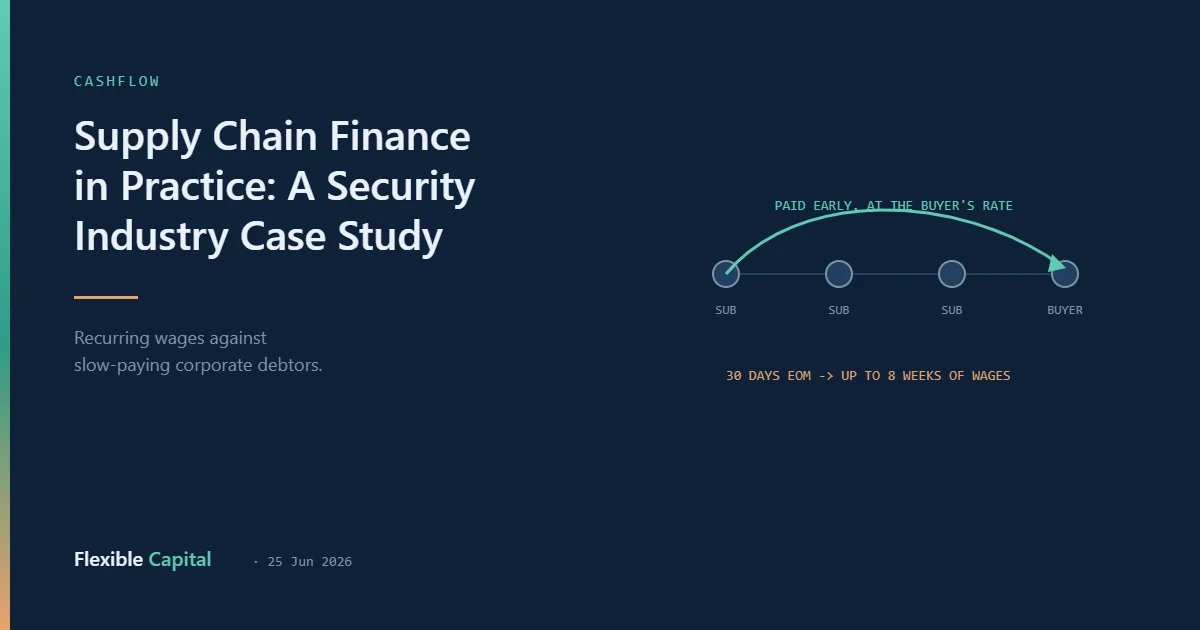
Security services is one of the clearest examples. Guards and patrol subcontractors are paid weekly or fortnightly. The corporate sites, facility managers and government departments they are deployed to typically pay on 30 days end of month, which in practice means five to eight weeks after the shift was worked.
Supply chain finance is built for that shape of business, and it is regularly confused with invoice finance. The two do different jobs.
What supply chain finance actually is
Supply chain finance sits on the payables side of your business rather than the receivables side. A financier pays your supplier and subcontractor invoices on your behalf, and you settle with the financier later, on terms that suit your cash cycle rather than your supplier’s.
The second half is what separates it from a line of credit. Your suppliers and subcontractors can elect to take early payment on invoices you have approved, drawing on the financier’s funds rather than yours, and each time one does you receive a rebate from the financier.
So the facility does two things at once. It gives you more time to pay, and it gives the people you rely on the option of being paid faster than your terms allow. Where good subcontractors are scarce and switch clients easily, that second point matters more than owners expect.
How it differs from invoice finance
Invoice finance funds money owed to you. You issue an invoice, a financier advances a percentage of it, and the facility is limited by the size and quality of your debtor ledger. Supply chain finance funds money you owe, and it is your standing as the buyer that supports it, not your customers’. The practical differences that tend to decide it:
- Who initiates it. Invoice finance is arranged by the seller. Supply chain finance is arranged by the buyer, who invites suppliers onto the platform.
- Where the cost falls. In invoice finance you pay to accelerate your own receivables. In supply chain finance a supplier who elects early payment accepts a discount to do so, and the buyer can earn a rebate.
- What it does to your other facilities. A well-structured supply chain finance facility can sit alongside an existing invoice finance line rather than competing for the same security.
The two are not really alternatives. They are opposite ends of the same cash cycle, and plenty of businesses run both.
The situation, and the constraint
A client of Flexible Capital in the security sector was looking to improve working capital. They already had an invoice finance facility with a tier 1 provider and had tried to have the limit extended.
That proved difficult, for reasons of usage pattern rather than credit quality. Their need was sporadic rather than constant, and a facility that sits idle for stretches and then spikes is hard to get an incumbent to size for the peaks.
Meanwhile the mismatch continued. Debtors generally paid on 30 days end of month, while suppliers and subcontractors required payment well before that money arrived.
So the obvious answer, more invoice finance, was not available on acceptable terms, and the next question was whether anything could be added without disturbing what was already in place. That constraint is common: a second facility often means competing registrations, a request for property security, or a conversation with the incumbent nobody wants to have. Anything on offer had to be additive.
The structure, and what happened
Flexible Capital worked with the client to establish a $400,000 supply chain finance facility.
Under it, the financier pays supplier and subcontractor invoices on the client’s behalf, and the client can defer payment to the financier where that helps manage working capital. Suppliers and subcontractors can separately opt to take early payment, and each time they do the client receives a rebate. Four features did most of the work:
- No set-up costs.
- No property security and no registrations, so the existing invoice finance facility was untouched.
- Used as needed, with no cost if the client elects not to fund invoices through the platform. For a business with sporadic demand, this was the point.
- A stronger supply chain, because funds are made available to suppliers early.
The financier provided direct training and support rather than handing over a login and leaving them to it. The client has commenced using the facility, and two things surprised them. The first was how user friendly the interface turned out to be, which is not trivial when your operations manager runs it between rosters. The second was how quickly suppliers embraced the system: uptake of early payment ran ahead of expectations, meaning more rebates to the client and better relationships with the subcontractors the business depends on.
When it is not the right answer
Supply chain finance suits businesses with a steady, meaningful spend with identifiable suppliers or subcontractors, customers on long terms, and enough standing for a financier to take buyer risk. Security, cleaning, labour hire, facilities management and construction services fit that description.
It fits poorly if your supplier base is fragmented and small, if your spend is mostly wages paid directly to employees rather than to subcontracting entities, or if suppliers will not come onto a platform. And like every cash tool it changes timing; it does not repair a business that is unprofitable at the job level.
Deferring payment also has an accounting and disclosure dimension worth raising with your accountant, particularly if you have covenants that treat payables and debt differently.
Where to start
Take one month of supplier and subcontractor payments and mark which you paid before you were paid for the related work. That total is the size of the problem, and a fair guide to whether a facility of this kind would earn its keep.
If it would, the team at Flexible Capital can walk you through how a supply chain finance platform would sit against the funding you already have.